
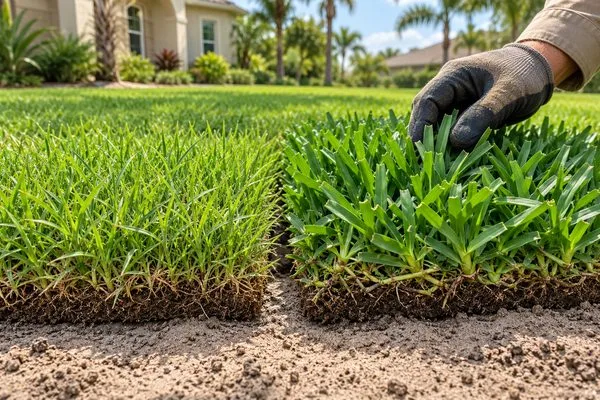
Choose St. Augustine if your yard has some shade and you want a thick, carpet-like lawn. Choose Bahia if your yard is in full sun and you want a tough, low-input lawn that tolerates drought. The grass you pick also shapes your lawn care plan, from mowing height to watering and fertilizer.
The right answer depends on your yard, not your neighbor's. To have someone look at yours, contact our team or call (407) 595-5818.
Which grass handles shade better?
St. Augustine handles shade far better than Bahia. Bahia needs full sun and thins out quickly under trees. According to UF/IFAS research on growing turfgrass in the shade, Bahia is not recommended for shady landscapes at all.
Not every St. Augustine is equal, though. Floratam, the most common variety in Florida, is much less shade tolerant than cultivars like Seville, Palmetto, CitraBlue, and ProVista. If you have live oaks shading half the yard, that cultivar choice matters.
One customer asked for the same sod his brother had, because his brother's lawn always looked perfect. We explained that conditions matter. His brother's yard may get open sun, while his had a lot of trees. We looked at his yard and talked through realistic options that would give him the best results.
That's common in older Orlando neighborhoods like College Park, where big canopy trees shade much of the yard. In deep shade, no grass thrives, and a mulched bed or ground cover may be the smarter call.
How do water needs and heat tolerance compare?
Bahia uses less water and survives drought by going dormant and turning brown, then greening back up when rain returns. St. Augustine stays greener through dry spells but needs more regular irrigation to look its best in Central Florida heat.
Both are warm-season grasses that love Orlando summers. The difference is how they look under stress. Bahia's open, upright growth and tall summer seedheads give it a rougher, more casual look. St. Augustine forms a dense, coarse-bladed carpet that crowds out more weeds when it's healthy.
St. Augustine does bring a few headaches. Chinch bugs love it in hot, dry weather, and it needs more fertilizer than Bahia. Bahia has its own pest, mole crickets, but generally takes less care overall.
Newer open-sun lots in communities like Lake Nona often suit Bahia well, especially on larger yards or side areas where a perfect look matters less than low upkeep.
How does your grass choice change the lawn care plan?
Your grass type sets the mowing height, the watering schedule, and how much feeding and pest monitoring the lawn needs. A good maintenance crew adjusts to the turf instead of cutting every yard the same way.
The UF/IFAS mowing guide recommends 2.5 to 4 inches for St. Augustine, with only dwarf types going below 3 inches, and 3 to 4 inches for Bahia. Both follow the one-third rule: never cut more than a third of the blade at once.
Bahia lawns often need mowing in summer just to knock down seedheads. St. Augustine benefits from close watching for chinch bug damage in dry stretches, which shows up as yellowing patches near driveways and sidewalks, common in sunny Baldwin Park yards.
Our lawn and landscape maintenance crews cut at the proper height for your turf type, sharpen mower blades daily, and rotate cutting patterns to reduce soil compaction and ruts.
What does proper sod installation involve?
Proper installation starts with prep. The old grass and weeds come out with a sod cutter, the debris gets hauled away, and the soil is graded so the new sod lies flat. Skipping prep is the most common reason new sod fails.
Irrigation comes next. We locate and flag sprinkler heads, check coverage, and confirm every area of new turf gets water. Our sod is grown locally and usually installed the same day it's cut, then edges are trimmed along walks, beds, and tree rings.
The first weeks make or break the result. New sod needs frequent watering until its roots grab the soil, so we reset the irrigation timer for establishment, then switch it back to a normal schedule once the sod roots in and starts growing. See the full process on our sod page.
Ready for a lawn that fits your yard? Get your free quote or call JLC Outdoors at (407) 595-5818, and we'll help you choose the right sod and the right plan to keep it healthy.