
8130 North Orange Blossom Trail Ste 200, Orlando FL 32810
Licensed & Insured | Free Estimates - Call Us Today

8130 North Orange Blossom Trail Ste 200, Orlando FL 32810
Licensed & Insured | Free Estimates - Call Us Today
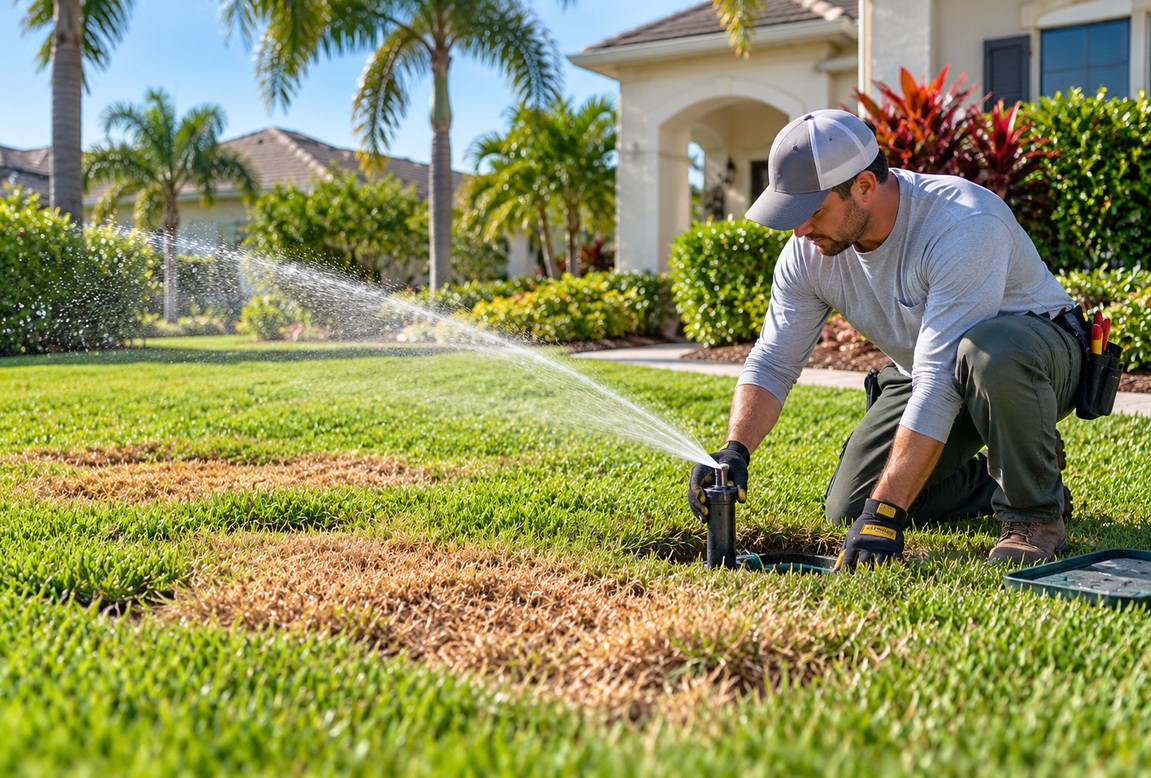
If the brown spots in your lawn sit in the same places every week, form neat circles or strips, or line up with a sprinkler head, the problem is usually coverage, not fertilizer or disease. A clogged, tilted, or broken head leaves a dry zone behind it, and no amount of lawn treatment will fix grass that isn't getting water. That's a sprinkler repair job.
We see this every week around Orlando. At JLC Outdoors Lawn & Landscape Services, our irrigation crews track brown patches back to a single faulty head more often than to anything else. If your lawn has dry spots you can't explain, give our team a call at (407) 595-5818 before you buy another bag of anything.
Each head is designed to overlap with the ones around it. When a single head stops spraying correctly, the patch it was supposed to cover dries out, and in Orlando's heat that happens fast.
The most common culprits are simple. A nozzle clogs with sand or debris and sprays a weak, uneven pattern. A mower or edger knocks a head sideways, so it waters the sidewalk or the side of the house instead of the grass. A head sinks below the St. Augustine as the turf grows up around it, and the grass blocks the spray. Or a riser cracks and the whole zone loses pressure, leaving the far end of the yard dry.
The pattern gives it away. A dry arc at the edge of the lawn, a brown wedge between two heads, or one yellowing corner of a zone usually points to coverage. On lawns in neighborhoods like Conway and Dr. Phillips, where many irrigation systems are twenty years old or more, we see mixed nozzle types on the same zone, too. Some heads put down far more water than others, so part of the zone stays soggy while the rest turns brown.
Because fertilizer, seed, and pest treatments all depend on water to work. If the sprinkler isn't reaching that spot, you're paying to treat grass that's simply thirsty.
Fertilizer on dry grass can actually burn it, and new seed or sod won't root without consistent moisture. Homeowners often assume chinch bugs or fungus, which are real problems for St. Augustine lawns in Central Florida. But pests and disease tend to spread and change shape, while a coverage problem stays in the same spot, week after week.
One homeowner in the Orlando area called us after he kept adding fertilizer to a brown patch he just couldn't fix. When we assessed his lawn, we found the problem was a sprinkler that was watering the doghouse instead of the lawn. The lawn never needed more fertilizer. It needed the water pointed back at the grass. If your yard needs more than water, our residential landscaping team can take care of the rest once the irrigation is working right.
A good audit runs every zone, checks every head, and measures how evenly water lands across the lawn. It also confirms the controller is set to the watering schedule Orlando homeowners are allowed to follow.
The technician turns on each zone and walks it, looking for clogged nozzles, tilted or sunken heads, broken risers, leaks, and heads spraying onto pavement. They check water pressure, since pressure that's too high turns spray into mist that blows away. Many use catch cups spread across the lawn to see how much water each area actually receives. Then they review the controller and rain sensor. Most of Central Florida falls under St. Johns River Water Management District rules, which limit which days you can water and prohibit watering in the middle of the day.
Our residential irrigation audits end with a clear list of what's wrong and what it takes to fix it, so you're not guessing.
The repair itself is usually quick, often one visit. Once water reaches the dry areas again, St. Augustine typically starts greening up within a few weeks, especially in the warm months.
Cleaning or replacing a nozzle, raising a sunken head, straightening a tilted one, or fixing a cracked riser is fast work for an experienced crew. More involved fixes, like a leaking valve or a damaged line, take a bit longer but still cost far less than resodding a lawn that dried out. After the repair, the lawn does most of the work on its own. Fill in bare spots only if the grass doesn't spread back naturally. Timing helps too. Catching a coverage problem during Orlando's dry spring, before the summer rains start, keeps a small dry spot from turning into a large patch of dead turf. Monthly maintenance visits catch knocked heads and clogged nozzles before they ever show up in the lawn.
If brown patches keep showing up in the same places, call (407) 595-5818 or schedule a sprinkler inspection. We'll find the cause and get your lawn back to an even green.